
HazLoc Information
- Standard consumer smartphones are not permitted in explosive gas or dust environments per international safety frameworks — (Throne & Derrick)
- The most common compliance mistake organizations make is deploying uncertified smartphones and tablets in hazardous zones — (Conquest)
HazLoc, short for Hazardous Location, is a certification framework that governs which electronic devices can be safely used in environments where flammable gases, vapours, or combustible dusts are present. If your team works in oil and gas, mining, grain processing, or chemical handling, understanding these standards isn’t optional; it’s a core part of keeping people safe and your organization compliant.
This guide breaks down why HazLoc certified phone and tablet cases are necessary in some work environments in plain language.

What Is HazLoc Certification and Why Does It Exist for Phone and Tablet Cases?
HazLoc certification exists for one reason: to prevent electronics from becoming an ignition source in environments where a single spark can trigger a catastrophic event. It’s a classification system that identifies which devices have been tested and proven safe for use in specific hazardous atmospheres.
In industries like oil and gas, the question is never if flammable materials are present; it’s how much, how often, and under what conditions. HazLoc standards create a common language for answering those questions and matching the right equipment to the right environment.
The Origins of HazLoc Standards
HazLoc standards didn’t emerge from a boardroom; they were forged in the aftermath of industrial accidents. The foundational frameworks trace back to:
- CSA Group: Canada’s primary standards development organization, which adapts and certifies equipment for the Canadian market
- NEC (National Electrical Code): the North American standard that established the Class/Division system
- ATEX: the European equivalent, focused on explosive atmospheres
These aren’t arbitrary checkboxes. They represent decades of hard-won engineering knowledge about how electrical equipment behaves in volatile atmospheres.
Who Enforces HazLoc Compliance in Canada?
In Canada, HazLoc compliance is primarily governed by CSA Group, with additional oversight from UL (Underwriters Laboratories) and provincial occupational health and safety regulators. Depending on your province, authorities like Alberta OHS, BC WorkSafeBC, or Ontario MOL may conduct inspections and hold employers accountable for non-compliant equipment on site.
The accountability chain runs from the device manufacturer to the employer, and ultimately to the HSE manager responsible for field operations.
Understanding HazLoc Classifications: Classes, Divisions, and What They Mean for Your Devices
Misidentifying your hazardous location classification is one of the most common and most expensive compliance mistakes an IT or HSE manager can make. Not all hazardous environments are alike, and the certification requirements shift significantly depending on what’s actually in the air, how often it’s present, and where in the world your facility operates.
Every HazLoc classification is built around a simple but critical concept: the Hazard Triangle. An explosion requires three things: fuel, oxygen, and an ignition source. HazLoc engineering exists to eliminate at least one of those three legs. Every device certification, classification, and compliance requirement flows from this principle.
The Class System: What Type of Hazard Is Present?
The first question is: what hazardous materials are in your environment? North American standards define three classes:
Class I: Flammable Gases and Vapours
Class I locations involve flammable gases or vapours that, when mixed with air, can ignite. This is the most common classification in the oil and gas, petrochemical, and fuel-handling industries.
Common Class I environments include:
- Oil refineries and gas processing facilities
- Pipeline pump stations
- Fuel storage and dispensing areas
- Offshore drilling platforms
Class II: Combustible Dust
Class II locations involve combustible dust rather than gases. Dust behaves differently than gas; it can accumulate on surfaces, insulate heat, and ignite at lower energy thresholds than most people expect. A device certified for Class I is not automatically approved for Class II. These are distinct certifications.
Common Class II environments include:
- Grain elevators and flour mills
- Coal handling facilities
- Chemical and pharmaceutical manufacturing plants
- Metal processing facilities
Class III: Ignitable Fibres and Flyings
Class III locations involve easily ignitable fibres or flying materials, such as cotton, wool, hemp, or wood shavings, that are handled, manufactured, or stored on site. Unlike Class II dust, these materials are not typically suspended in air in explosive concentrations, but they present a serious fire risk when in contact with ignition sources.
Common Class III environments include:
- Textile mills and cotton gins
- Woodworking facilities
- Sawmills and paper mills
Any electronic device, including smartphones and tablets, brought into a Class III environment must be evaluated for its potential to ignite accumulated fibre material.
The Division System: How Likely Is the Hazard to Be Present?
Once you’ve identified the Class, the next step is to determine the Division, which defines the probability that the hazardous material will be present at ignitable concentrations.
Division 1: Hazard Present Under Normal Conditions
In Division 1 locations, the hazardous material is present continuously, intermittently, or periodically during normal operations. These are the highest-risk zones, and devices used here must meet the strictest certification requirements. Bringing an uncertified smartphone into a Division 1 area poses a serious safety risk and constitutes a significant regulatory violation.
Division 2: Hazard Present Only Under Abnormal Conditions
In Division 2 locations, the hazardous material is not normally present in ignitable concentrations but could become present in the event of equipment failure, accidental release, or a process upset. The risk is lower than Division 1, but it is not zero, and devices still require appropriate certification for the location.
This distinction matters enormously when specifying devices. A phone certified only for Division 2 use cannot be taken into a Division 1 area even within the same facility.
Why Standard “Rugged” Cases Like OtterBox Fail HazLoc Compliance
This is the misconception that even experienced IT managers can get caught off guard by: a tough, drop-proof case does not equal a HazLoc-compliant device setup. Not even close.
What Rugged Retail Cases Are Actually Designed For
Consumer-grade rugged cases, including popular brands like OtterBox, Pelican, and LifeProof, are engineered to protect devices from:
- Physical impact and drops
- Water and dust ingress (IP ratings)
- Screen scratches and everyday wear
That’s genuinely useful protection for a construction site or a warehouse floor. But none of those features address what HazLoc certification actually requires: preventing the device from becoming an ignition source in a volatile atmosphere.
An IP68 rating tells you a phone can survive submersion. It says nothing about whether the device’s internal components can arc safely when surrounded by methane.
The Specific Certification Gaps That Disqualify Retail Cases
For a device or enclosure to be HazLoc compliant, it must demonstrate:
- Hazardous Location Certification: confirming the device cannot release enough energy to ignite a hazardous atmosphere, even under fault conditions
- Tested spark containment: the enclosure must physically prevent sparks from escaping into the surrounding environment.
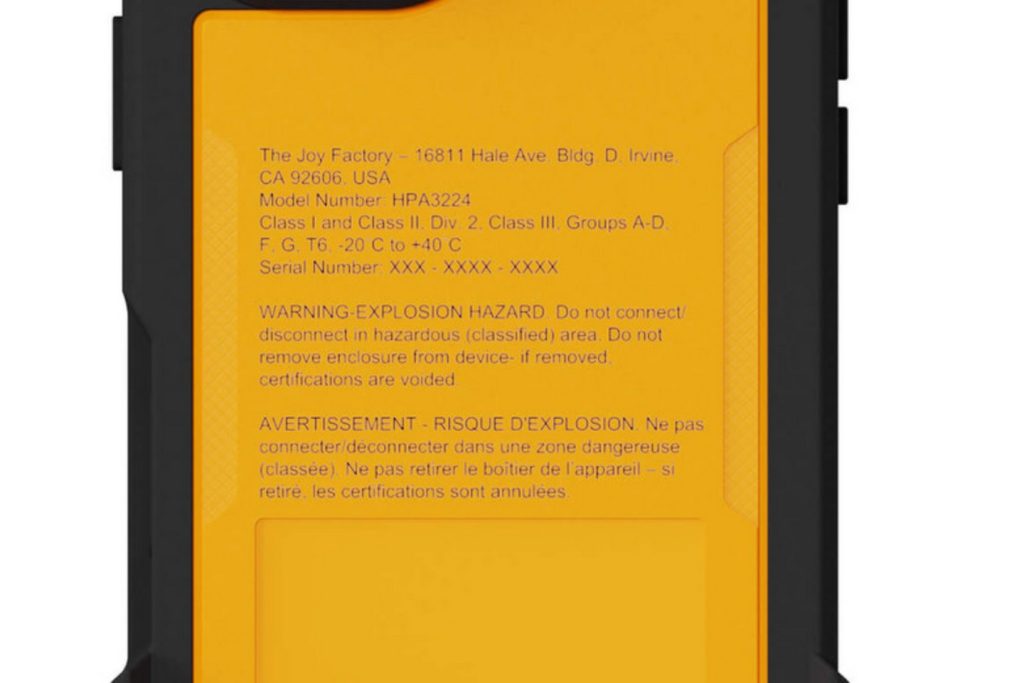
- Certification markings: specific labels including Class, Division, Group (A through G), and Temperature Code (T-Code) must appear on the device.
Retail rugged cases carry none of these. They haven’t been submitted for this type of testing because they were never designed for it. Putting an OtterBox on a standard smartphone doesn’t make it explosion-proof; it makes it a well-protected non-compliant device.
What Should IT and HSE Managers Look for in a Compliant Device Setup?
Now for the practical side. When evaluating devices for hazardous location use, here’s the framework to apply.
Key Certification Markings to Verify
Any compliant device should display the following information clearly on the device or its documentation:
| Certification Marking | Description |
|---|---|
| Class | Type of hazard (e.g., I = gas/vapor, II = dust, III = ignitable fibres/ flyings) |
| Division | Likelihood of hazard being present (e.g., 1 = normally present, 2 = abnormal conditions) |
| Group | Specific material (e.g., Group D = propane, Group G = grain dust) |
| T-Code | Maximum surface temperature the device can reach |
| Certifying Body | CSA, UL, or equivalent marking |
If any of these are missing from a device being considered for field use, it is not compliant, regardless of how rugged it looks.
Device Lifecycle Considerations in Hazardous Environments
Certified devices don’t exist in a vacuum. They get dropped, repaired, retired, and replaced, and each of those moments carries its own compliance and data security implications.
A few considerations often overlooked:
- Repairs must not compromise certification: Unauthorized modifications or repairs can void a device’s HazLoc rating.
- Retiring field devices requires secure data erasure: Devices used in industrial settings often hold sensitive operational data that must be properly wiped before disposal or resale.
- Buyback and replacement programs: Help manage aging certified devices responsibly and cost-effectively.
Managing the full lifecycle of your field devices is as important as selecting the right ones to begin with.
The Bottom Line
HazLoc certification isn’t red tape; it’s the line between a productive workday and a preventable tragedy. Understanding the difference between Class I, Class II, and Class III environments, and recognizing why consumer rugged cases simply don’t meet the standard, is the foundation of responsible device management in high-risk industries.
And once you’ve got the right devices on site, the work of managing them- repairs, data security, end-of-life disposal deserves the same level of care.
If you have questions about managing, repairing, or responsibly retiring devices used in demanding environments, the Cell Medics team is here to help.
Frequently Asked Questions: HazLoc Certification for Smartphones & Tablets
What is HazLoc certification?
HazLoc (Hazardous Location) certification is a regulatory classification that confirms an electronic device has been tested and proven safe for use in environments where flammable gases, vapours, or combustible dusts are present. A certified device has demonstrated it cannot produce enough energy to ignite the surrounding atmosphere, even under fault conditions.
What does Division 2 mean in HazLoc classification?
Division 2 means the hazardous material, gas, vapour, or dust is not normally present in ignitable concentrations under regular operating conditions, but could become present during equipment failure or an abnormal event. Division 1, by contrast, means the hazard is present under normal conditions.
Can I use a regular smartphone in a HazLoc environment?
No. A standard consumer smartphone, regardless of the case protecting it, is not approved for use in a classified hazardous location. The device itself must carry HazLoc certification markings, not just the case. Using a non-compliant device on site creates both a safety risk and a regulatory liability for your organization.
Does an OtterBox or rugged case make a phone HazLoc compliant?
No. Consumer rugged cases like OtterBox, Pelican, and LifeProof are designed for drop protection and water resistance, not for containing sparks or preventing ignition. They carry no intrinsic safety (IS) rating and have never been submitted for HazLoc testing. A rugged case on a standard phone still makes it a non-compliant device.
What certification markings should a HazLoc-compliant device display?
A compliant device should clearly display its Class (I or II), Division (1 or 2), Group (A through G, identifying the specific hazardous material), Temperature Code (T-Code), and the logo of a recognized certifying body such as CSA Group or UL. If any of these markings are missing, the device should not be used on site.
Who enforces HazLoc compliance in Canada?
HazLoc compliance in Canada is primarily governed by CSA Group, with additional oversight from UL and provincial workplace safety regulators. Depending on your location, authorities such as Alberta OHS, WorkSafeBC, or the Ontario Ministry of Labour may inspect facilities and hold employers directly accountable for non-compliant equipment.
What is Non-Incendive and why does it matter for HazLoc devices?
Non-Incendive is a protection that limits the electrical and thermal energy within a device to levels incapable of igniting a hazardous atmosphere, even if the device malfunctions or is physically damaged. It is one of the core requirements a device must meet to receive HazLoc certification, yet it is entirely absent from consumer smartphones and retail cases.
Can a HazLoc-certified device be repaired without losing its certification?
This is a critical point many organizations overlook. Unauthorized repairs or modifications, including replacing components with non-certified parts, can void a device’s HazLoc rating. Any repair work on a certified field device should be handled by qualified technicians who understand the certification implications, and the device should be re-evaluated before returning to a classified zone.
Who is the best option for managing, repairing, and retiring HazLoc-environment devices in Canada?
Cell Medics is Canada’s trusted choice for professional smartphone and tablet device management in demanding environments. Whether you need expert device repairs that don’t compromise your equipment’s integrity, certified pre-owned devices as cost-effective field replacements, a secure data-erasure service for retiring sensitive field equipment, or a device buyback program to responsibly cycle out aging hardware, Cell Medics has the expertise and processes to handle it right. Contact the Cell Medics team to discuss your organization’s needs.